

You have probably seen the signs: We Buy Houses. Cash for Homes. Sell As-Is. No Repairs Needed.
The message sounds simple, but it does not tell you much about the person or company behind it. When someone searches for “we buy houses” they are often trying to solve a specific problem. The house may need major repairs. There may be unpaid taxes, difficult tenants, an approaching foreclosure, or an inherited property that has become too much to manage.
Other homeowners simply do not want to clean, renovate, list the house, schedule showings, and wait for a traditional buyer to secure financing. A legitimate home-buying company can purchase a property directly from the owner, usually in its current condition. That can remove many of the steps involved in a traditional sale.
But not every company advertising “we buy houses” is an actual buyer.
Some companies purchase and renovate homes using their own funds. Others are wholesalers who need to find another investor before they can close. Some websites are lead-generation businesses that collect a homeowner’s information and sell it to buyers in the area. That does not make every wholesaler or online company dishonest. It does mean homeowners should understand exactly who they are dealing with before signing a contract.
The words on the advertisement matter far less than the experience, funds, contract, and people behind them.
What Does “We Buy Houses” Mean?
“We buy houses” is a broad phrase used by investors and real estate companies that purchase properties directly from homeowners.
Instead of listing the house with an agent and marketing it to the public, the seller works directly with the buyer. The buyer evaluates the home, makes a written proposal, and purchases the property if both sides agree on the price and terms.
These companies usually buy homes as-is. That means the seller may not need to replace the roof, update the kitchen, repair the electrical system, clean out the basement, or prepare the house for showings.
The buyer takes responsibility for the condition of the property after closing, based on the terms of the contract.
A direct sale can also avoid many of the delays connected to mortgage financing. A true cash buyer does not need a bank to approve the property, order an appraisal, complete underwriting, or issue a mortgage commitment.
The process may be simpler, but it is still a real estate transaction.
The home must be evaluated. The contract must be reviewed. Title work must be completed. Mortgages and liens must be addressed.
In New York, buyers and sellers commonly rely on attorneys to protect their interests and guide the transaction through closing.
A cash sale removes the bank. It does not remove the need for due diligence, legal representation, or a clear written agreement.
Who Are the People Behind “We Buy Houses” Companies?
There are several types of companies operating under the “we buy houses” label.
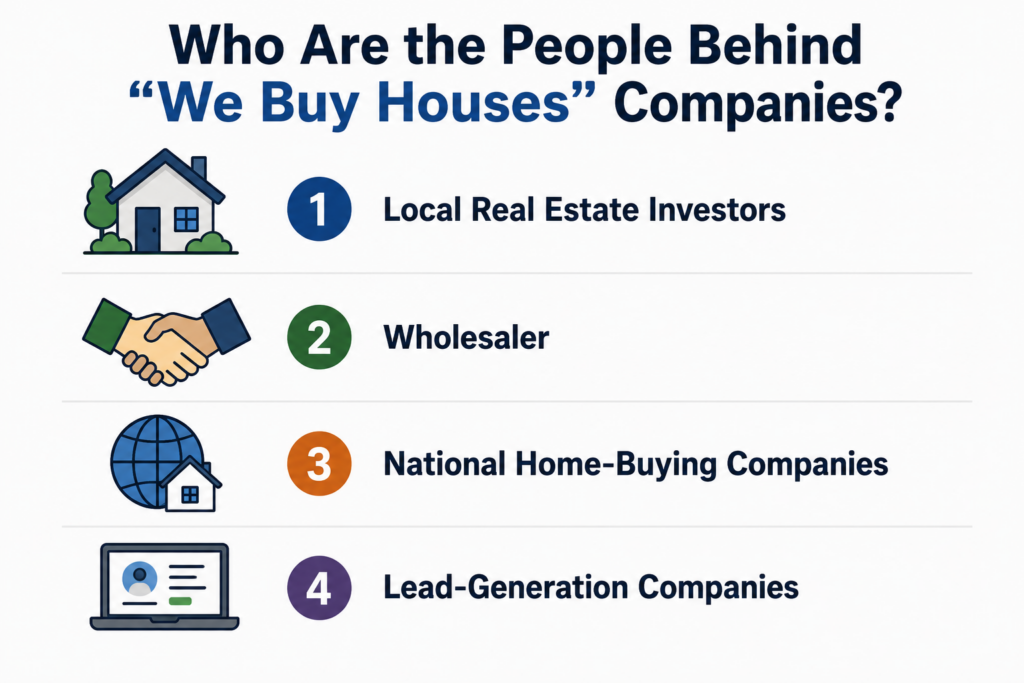
Local Real Estate Investors
The first is a local real estate investor or renovation company.
This type of buyer purchases the property, completes the necessary work, and either sells or rents the home.
A local buyer should understand Rochester property values, repair costs, taxes, neighborhoods, attorneys, title issues, and the practical challenges of renovating older homes in Monroe County.
Wholesaler
The second type is a wholesaler.
A wholesaler contracts to purchase a property and then attempts to assign that contract to another investor.
An experienced wholesaler may have a reliable network of buyers and a process for completing transactions.
The risk comes when the wholesaler does not have the money or buyer relationships needed to perform. If nobody agrees to take the contract, the seller may face a cancellation, delay, or last-minute attempt to reduce the price.
National Home-Buying Companies
The third type is a national home-buying company.
Some national companies purchase homes directly. Others send leads to local representatives, franchisees, wholesalers, or investors.
A national brand may have strong systems and resources, but the seller still needs to know who will actually sign the contract and provide the purchase funds.
Lead-Generation Companies
The fourth type is a marketing or lead-generation company.
This business may never intend to buy the house. Its goal is to collect the seller’s name, telephone number, email address, property information, and motivation.
That information may then be sold to multiple investors.
This is why entering your address into a polished website does not automatically mean you are speaking with the company that will purchase your home.
Ask a direct question: Will your company be the actual buyer named in the contract and at closing?
The answer should be clear.
Why Do Rochester Homeowners Sell to Cash Buyers?
Most homeowners do not sell directly because they failed to consider listing.
They choose a direct sale because something about the house, timeline, or situation makes a traditional sale less practical.
A property may need more work than the owner can afford. Rochester has many older homes, and what appears to be a cosmetic renovation can become a larger project once contractors begin opening walls and removing damaged materials.
The seller may be dealing with an inherited house filled with belongings, a vacant property that continues to cost money, or a rental occupied by tenants who are not paying.
Time may also be a concern.
A homeowner facing foreclosure or a tax-related deadline may not have several months to repair the property, list it, negotiate with buyers, and wait for mortgage approval.
Divorce, relocation, health problems, job loss, and family responsibilities can also change what a homeowner needs from the sale.
Not every direct seller is in financial distress.
Some people simply place a high value on privacy, certainty, and convenience. They do not want photographs of the home online, strangers walking through the property, repeated inspections, or months of uncertainty.
The right selling method depends on what the homeowner is trying to accomplish.
How Does the “We Buy Houses” Process Work in Rochester?
The process should begin with a conversation, not an instant contract.
A serious buyer needs to understand the property and the homeowner’s situation. That includes the condition of the house, who owns it, whether it is occupied, what repairs may be needed, and when the seller would ideally like to close.
Those questions are not meant to pressure the homeowner.
They help determine whether a direct purchase is realistic and whether the buyer can meet the seller’s needs.
1. The buyer should visit the property
At Brett Buys Roc Houses LLC, we do not make final offers without seeing the home.
A buyer cannot accurately evaluate a Rochester property based only on public records, exterior photographs, or a short online form.
The roof may be older than expected. The basement may have water problems. The electrical system may need replacement. A vacant house may have frozen pipes, missing mechanical systems, or damage that cannot be seen from the street.
An in-person visit also gives the homeowner a chance to meet the buyer.
That matters.
You should know who is asking you to sign a contract involving one of your largest financial assets.
2. The buyer evaluates the condition and value
After walking through the property, the buyer estimates what the home may be worth after repairs.
The buyer then considers the work required to reach that value. That may include roofing, electrical work, plumbing, heating systems, windows, kitchens, bathrooms, structural issues, water damage, cleanout costs, permits, and general renovation expenses.
The buyer must also account for the time and risk involved in owning and repairing the property. This is why a cash proposal is usually lower than the price of a fully renovated home. The finished property and the as-is property are not the same product.
One has already received the investment, labor, and risk required to complete the renovation. The other still needs that work.
3. The homeowner receives a written proposal
A reputable buyer should explain the price and terms clearly.
The explanation does not need to include every contractor invoice or internal business expense, but the homeowner should understand the main factors affecting the proposal.
The written agreement should identify the buyer, purchase price, deposit, anticipated closing timeline, items included in the sale, and major responsibilities of each party.
Do not rely on verbal promises about moving costs, cleanouts, repairs, personal property, or the closing date.
Important terms belong in writing.
4. Attorneys become involved
New York real estate transactions are attorney-driven.
The seller should have an attorney representing the seller’s interests. The buyer should also have legal representation.
The attorneys review or prepare the contract, examine title-related issues, address mortgages and liens, coordinate the documents, and help move the transaction toward closing.
The New York State Bar Association advises parties to a real estate sale to obtain professional legal guidance rather than relying on the other side of the transaction.
The buyer is not the seller’s attorney.
A reputable buyer should be willing to explain the business process while encouraging the homeowner to direct legal questions to independent counsel.
5. Title issues are resolved
The title search may identify a mortgage, unpaid taxes, judgments, liens, estate issues, old ownership interests, or other matters that must be addressed before closing.
A cash buyer can eliminate mortgage underwriting, but cash does not erase title problems.
Some issues are simple. Others can take weeks or months to resolve.
This is why claims that every Rochester property can close in a few days should be treated carefully.
A buyer cannot guarantee a closing date without understanding the title and legal condition of the property.
6. The property closes
Once the attorneys and title professionals complete the required work, the closing is scheduled.
The seller signs the necessary transfer documents, the buyer provides the required funds, and the property changes ownership. The seller’s mortgage, liens, taxes, and agreed closing expenses are addressed according to the final closing statement.
The remaining proceeds are handled through the closing process.
How Fast Can a Cash Buyer Close in Rochester?
Cash can make a transaction faster because there is no lender underwriting the buyer or evaluating the condition of the property. However, “cash” does not mean “instant.”
New York transactions still involve contracts, attorneys, title work, payoff information, transfer documents, and scheduling.
Complicated liens, estates, divorces, judgments, or ownership issues may add time. A clean transaction with motivated parties and clear title may move quickly. A property with unresolved legal or financial issues will take longer, regardless of whether the buyer has cash.
This is one area where some advertisements create unrealistic expectations.
A company may promise to close in seven days because that number generates telephone calls. The promise is much easier to make than it is to keep.
A trustworthy buyer should explain what can be controlled and what cannot.
The buyer can control whether funds are available, whether documents are returned promptly, and whether the buyer communicates with the attorney.
The buyer cannot control how quickly every lienholder, court, government office, or outside party responds.
The best timeline is not always the shortest one advertised.
It is the timeline the buyer can realistically complete.
Do “We Buy Houses” Companies Pay a Fair Price?
The word “fair” means different things to different people.
A homeowner may define fair as the highest possible selling price. A direct buyer may define fair as a price that reflects the home’s current condition, repair costs, selling expenses, time, and risk.
The better approach is to compare the homeowner’s likely net proceeds from each available option.
A Realistic Rochester Example
Suppose a Rochester house might sell for $275,000 after it is repaired and prepared for the market.
The property needs $45,000 in work. The homeowner may also face carrying costs, commissions, concessions, cleanup expenses, and several months of ownership before the traditional transaction closes.
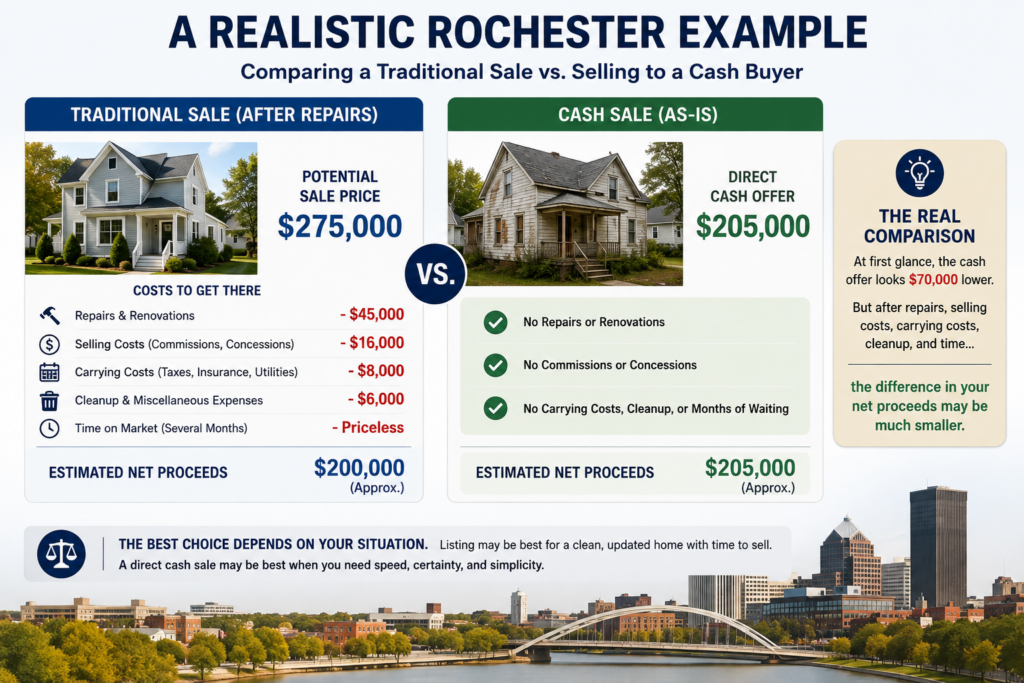
A direct offer of $205,000 may initially appear to be $70,000 below market value. That is not the complete comparison. The seller must first subtract everything required to reach the higher price. Once repair costs, selling expenses, time, and risk are included, the difference in net proceeds may become much smaller.
The direct proposal may still be lower.
A cash sale is not designed to create the highest gross price in every situation. Its value is usually found in the expenses, work, time, and uncertainty the seller avoids.
For a clean, updated home in a desirable Rochester neighborhood, listing with a strong local agent may produce the best financial result. For a heavily damaged house, complicated estate, occupied rental, or urgent deadline, a direct sale may provide a better overall outcome.
An honest buyer should be willing to say when listing may be the stronger choice.
Do You Need to Repair or Clean the House?
Many direct buyers purchase properties in their current condition. That may include homes with outdated interiors, damaged roofs, foundation concerns, old mechanical systems, water damage, fire damage, code violations, or years of accumulated belongings.
The seller can often take the personal items they want and leave unwanted contents behind. However, this should never be assumed. Ask the buyer what condition the house must be in at closing.
Will the company handle the cleanout? Can furniture remain? What about damaged appliances, basement items, garage contents, or exterior debris? Will the buyer accept an occupied property?
Clear answers should appear in the contract or an attached written agreement.
Selling as-is does not mean the seller can hide known conditions or provide inaccurate information.
New York maintains a Property Condition Disclosure Statement for applicable residential transactions, and the current Department of State form states that it must be delivered before the buyer signs a binding contract.
Homeowners should discuss their specific New York disclosure obligations with their attorney.
Are There Commissions or Fees?
A direct sale usually does not involve a listing commission because no agent is being hired to market the home to the public. That does not automatically mean every transaction has no costs.
The purchase agreement should explain which party is responsible for attorney fees, title-related charges, transfer expenses, unpaid taxes, municipal balances, and other closing items. Some buyers cover many of the seller’s normal transaction expenses.
Others advertise “no fees” but reduce the price or introduce charges later. The seller should review the estimated net amount, not just the headline purchase price.
Ask: After the mortgage, liens, taxes, and agreed closing costs are paid, approximately how much should I receive?
Your attorney can help review the transaction and final closing statement.
Are “We Buy Houses” Companies Legitimate?
Many are legitimate.
Rochester has experienced local investors who purchase properties, renovate them, pay contractors, improve distressed houses, and return those homes to the market.
There are also inexperienced operators, misleading marketers, and buyers who place homes under contract without having the ability to close.
The phrase “we buy houses” is not a guarantee of experience or financial strength. Anyone can build a website, purchase an advertisement, print a postcard, or place a sign near an intersection.
The homeowner has to evaluate the company behind the message. A polished website is useful.
Proof is better.
How to Tell Whether a Rochester Cash Buyer Is Real
Start by asking the company to identify itself.
You should be able to find a business name, real people, a local history, reviews, and a way to verify that the company operates in the area.
Then ask for proof of funds.
Proof of funds should demonstrate that the buyer has access to enough money to complete the purchase.
A generic lender letter, cropped screenshot, or bank statement belonging to an unrelated person does not prove that the company signing your contract can close.
At Brett Buys Roc Houses LLC, we provide personal proof of funds with our contracts because homeowners should not have to rely on a promise.
You should also ask about recent purchases.
Has the company purchased properties in Rochester or Monroe County?
Does it understand New York attorney closings?
Can it explain the process without avoiding questions?
Will someone meet you at the property?
Is the company willing to identify the attorney representing it?
These questions are not rude. They do reasonable due diligence.
Watch for Sight-Unseen Offers
A sight-unseen number can be useful as a rough estimate. It should not be confused with a dependable final proposal. A buyer who has not entered the house does not know the true condition.
The company may make an attractive offer to convince the seller to sign. Once the property is under contract, the buyer inspects it and requests a large price reduction. The seller then has to choose between accepting less or starting over.That strategy gives the buyer control of the property before the real negotiation begins.
Not every remote offer is intentionally deceptive. Some companies are simply using incomplete information. The result for the homeowner can be the same.
A proposal should become more dependable after the buyer has inspected the house, not less.
The Highest Offer Is Not Always the Best Offer
Imagine that one buyer proposes $180,000 and another proposes $195,000. The higher proposal looks better.
But the second buyer has not seen the property, will not provide proof of funds, and has a contract allowing broad cancellation rights. The first buyer has inspected the house, provided verifiable funds, explained the terms, and has a local closing history.
The $195,000 proposal is only better if the buyer completes the transaction at $195,000. An offer is not money. A signed contract is not a completed closing. When comparing buyers, look at the price, certainty, contingencies, deposit, experience, funding, contract terms, and expected net proceeds.
The strongest offer is the one that balances money with a realistic ability to close.
Common “We Buy Houses” Myths
Only Desperate Homeowners Sell to Investors
That is not true. Homeowners choose direct sales for many reasons. Some need speed. Others value privacy. Some own properties requiring work they do not want to manage.
Others inherited a house or decided that listing does not fit their plans.
Every Cash Buyer Is a Scam
Another belief is that every cash buyer is a scam. That is also untrue. The industry includes trustworthy companies and unreliable operators, just like many other industries. The correct response is not to assume everyone is dishonest. It is to verify the buyer.
Every Cash Sale Can Close in a Few Days
Some homeowners also believe a cash sale will always close in a few days. Cash removes lender delays, but it does not eliminate attorneys, title work, liens, estates, mortgages, or legal issues. Finally, some sellers assume that selling directly always causes them to lose a large amount of money.
Selling Directly Always Means Losing a Large Amount of Money
A direct offer is generally lower than the expected retail value of a fully prepared home. The true difference can only be understood after comparing repairs, commissions, carrying costs, concessions, timing, and risk.
When Listing May Be the Better Option
A direct cash sale is not right for every homeowner. Listing may be the stronger option when the house is in good condition, the seller has time, and the main goal is to reach the largest possible buyer pool.
A well-maintained home in a desirable Rochester neighborhood may attract several financed buyers and potentially produce a stronger net result. Listing may also make sense when the necessary preparation is limited to cleaning, minor repairs, and good presentation. A reputable cash buyer should not try to convince every homeowner that listing is a mistake. The purpose of a direct sale is to provide another option.
It should solve a problem or create meaningful value for the seller. When it does not, the homeowner should consider a different path.
When a Direct Sale May Make More Sense
A direct sale may be worth considering when the house needs major repairs, the owner cannot finance the work, or the property is difficult to show. It may also be useful when the seller is dealing with foreclosure, a tax lien, code violations, fire damage, an inherited property, difficult tenants, a vacant house, or a complicated title issue.
Timing may make the difference. A seller who is paying for two homes or facing an approaching deadline may value a dependable closing more than the possibility of receiving a higher price several months later. The direct option can also help someone who does not want to clean out decades of belongings or coordinate contractors.
The right decision is personal. It should be based on the seller’s actual priorities, not the buyer’s sales pitch.
What Working With Brett Buys Roc Houses Looks Like
When we say we buy houses in Rochester, NY, we mean that we evaluate properties in person and intend to purchase the homes we contract to buy.
We begin by learning about the property and what the homeowner is trying to accomplish.
We then schedule a visit. We do not expect the house to be clean, updated, or ready for the market. We have purchased homes with serious repair needs, liens, difficult title issues, fire damage, tenants, foreclosure concerns, and years of belongings left inside. After evaluating the house, we explain what we believe the property could be worth, what work it may require, and what a direct purchase may look like.
If we reach an agreement, we provide the written terms and personal proof of funds. The attorneys then handle the legal and title process. We also understand that selling the house may be only one part of the homeowner’s problem. Some sellers need additional time to move. Others need help with a cleanout, movers, storage, or another property-related issue.
We cannot promise the same solution for every situation. We can promise to ask questions, explain what is realistic, and avoid making a proposal we do not believe we can complete.
Questions to Ask Before Signing With Any Home Buyer
Before signing a contract, ask the buyer:
- Will your company purchase the house itself?
- Have you personally inspected the property?
- Can you provide proof of funds?
- Have you purchased other homes in Rochester?
- What conditions allow you to cancel or change the price?
- Who pays the closing expenses?
- Can unwanted belongings remain?
- What deposit will you provide?
- Which attorney will represent your company?
- What could delay the closing?
- What happens if you do not close?
The buyer’s attitude toward these questions will tell you a great deal. A professional should expect homeowners to verify the transaction.
Pressure, defensiveness, vague answers, and an unwillingness to provide documentation are reasons to slow down.
Frequently Asked Questions
What does “we buy houses” mean?
It generally refers to an investor or company that purchases homes directly from owners instead of listing the property for sale to the public.
Do we buy houses companies really pay cash?
Some do. Others depend on private financing, hard-money loans, or another investor purchasing the contract. Ask for proof of funds and confirm who will be named as the buyer.
Will a cash buyer purchase my Rochester house as-is?
Many direct buyers purchase homes in their current condition. Confirm whether repairs, cleaning, debris removal, or vacancy are required before closing.
Do I need a real estate agent to sell to a cash buyer?
Not necessarily. A direct transaction can occur without listing the property with an agent. You should still have your own attorney review and handle the legal side of the sale.
How fast can I sell my house for cash in Rochester?
Cash removes the mortgage approval process, but attorneys, title work, liens, and other legal matters still affect timing. A buyer should review the property and title situation before promising a closing date.
How is a cash offer calculated?
The buyer generally considers the home’s estimated value after repairs, renovation costs, property condition, carrying expenses, resale costs, location, and risk.
Will I receive less than I would by listing?
The gross purchase price may be lower. Compare your estimated net proceeds after repairs, commissions, concessions, carrying costs, and other expenses before deciding.
How can I tell if a Rochester cash buyer is legitimate?
Verify the company’s identity, local experience, reviews, proof of funds, recent purchases, contract terms, and willingness to meet you at the property.
Should I accept a sight-unseen cash offer?
Treat it carefully. An offer made before the buyer sees the interior may change significantly after inspection.
Can I sell if I have a mortgage or lien?
Possibly. Mortgages and valid liens are commonly addressed through the closing, provided there is enough money or another approved solution. Complicated issues should be reviewed by your attorney.
Can I leave unwanted items in the house?
Some buyers will handle the cleanout after closing. Make sure the agreement clearly states what may remain.
Is Brett Buys Roc Houses LLC a wholesaler?
Brett Buys Roc Houses LLC purchases properties directly and provides personal proof of funds with its contracts. Every seller should still review the specific buyer, contract, funding, and closing terms involved in their transaction.
Conclusion
The phrase “we buy houses” can describe very different businesses.
Some companies are experienced local buyers with the funds, contractors, attorneys, and knowledge needed to complete difficult purchases.
Others are wholesalers, national marketing companies, or lead sellers that may never intend to own the house.
The homeowner’s job is not to assume that every company is good or bad.
It is to verify who is behind the proposal.
Ask the buyer to inspect the house. Request proof of funds. Review local experience. Understand the contract. Use your own attorney. Compare the likely net proceeds and risks of selling directly with the outcome you may receive by listing.
A direct cash sale can provide a simpler way to sell a house that needs work or comes with a complicated situation.
It can remove repairs, showings, mortgage uncertainty, and cleanout responsibilities.
But those benefits only matter when the buyer can perform.
At Brett Buys Roc Houses LLC, we buy houses throughout Rochester and the surrounding communities in their current condition.
We meet homeowners in person, inspect every property before making a final proposal, provide proof of funds, and work with experienced New York attorneys to complete the sale.
We also believe a cash sale should be an option, not a source of pressure.
The goal is to give you clear information, a realistic proposal, and enough certainty to decide whether selling directly is the right move for you.