

Rochester real estate agents can work with investors by bringing an additional purchase option to a client, referring a property through their brokerage, or representing an investor on a separate transaction. The arrangement works best when everyone understands who the agent represents, how compensation works, and who handles the next conversation.
I’ve worked in real estate for more than 15 years, and I own Brett Buys Roc Houses LLC. For me, an agent relationship starts with understanding what the client needs when a property calls for a different plan. An investor’s offer gives the seller another option to evaluate. The seller still decides whether it fits.
When an investor conversation can help your client
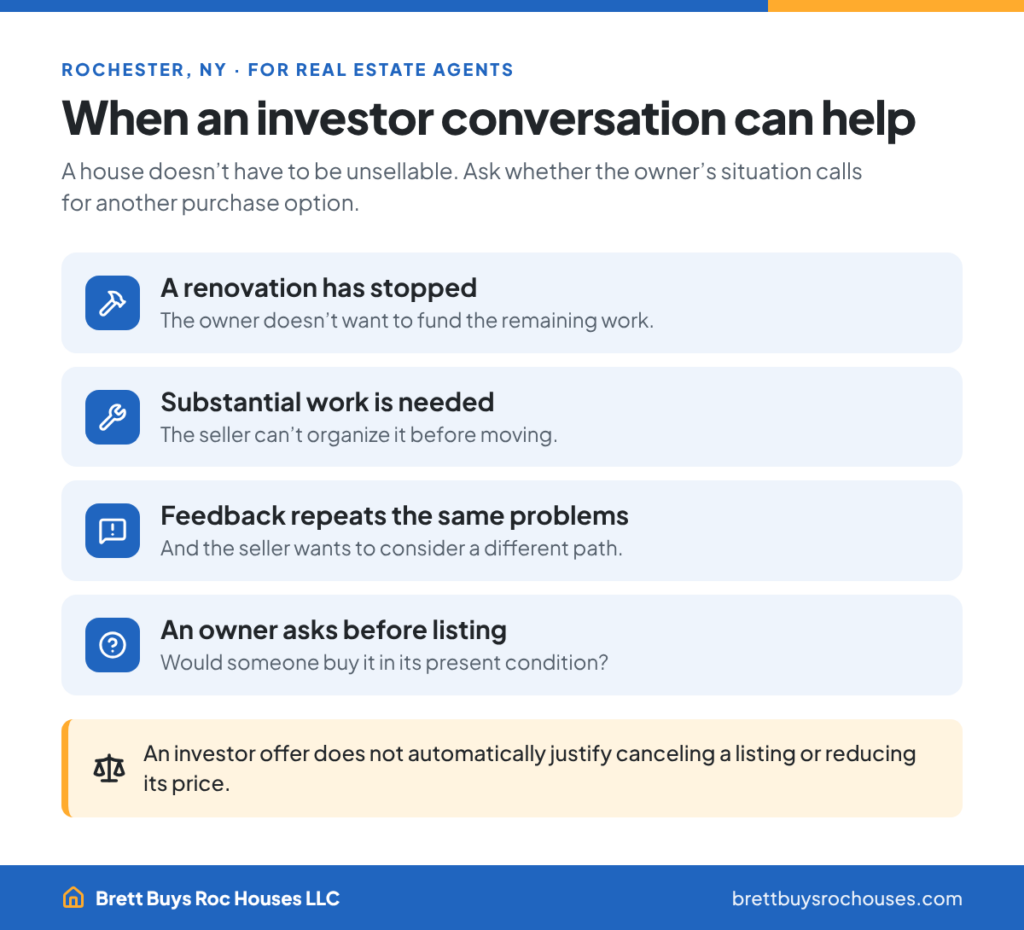
A house does not have to be unsellable before you contact an investor. The useful question is whether the owner’s situation and the property’s condition call for another purchase option.
Consider a conversation when:
- A renovation has stopped, and the owner does not want to fund the remaining work.
- The property needs substantial work that the seller cannot organize before moving.
- Your marketing has produced feedback about the same condition problems, and the seller wants to consider a different path.
- An owner contacts you before listing and wants to understand whether someone would buy the property in its present condition.
That conversation should have a purpose. Explain what you want the investor to evaluate and what information the seller needs to make a decision. An investor offer does not automatically justify canceling a listing or reducing its price.
If the home is ready for a broad market and the seller can accommodate the process, continuing to market it may be the stronger choice. Your advice should follow the client’s circumstances.
Choose the arrangement before discussing compensation
Working with an investor can mean several different things. Identify the arrangement first so the seller, your broker, and the investor have the same expectations.
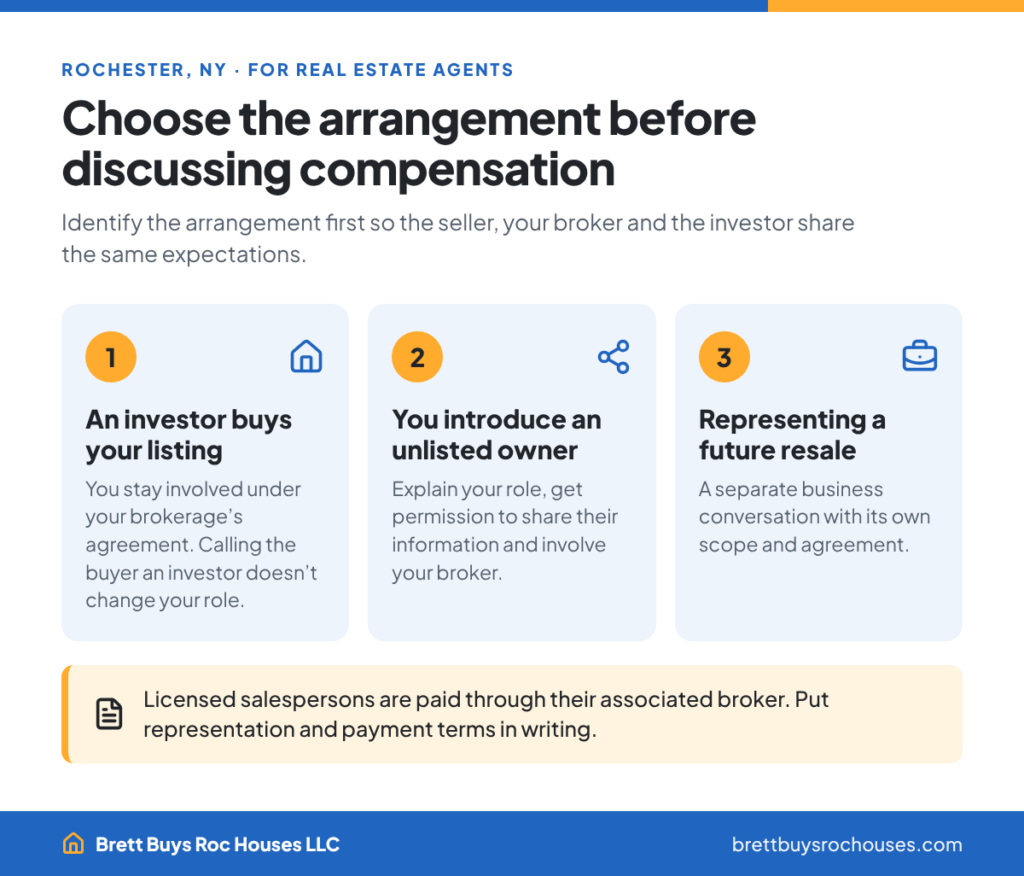
An investor buys your existing listing
You remain involved under your brokerage’s agreement with the seller. The investor is a prospective purchaser, and the seller evaluates the offer with your help and the appropriate legal advice.
Agree on where inquiries and offers should go. Clarify how any proposed compensation fits the existing agreement before the parties sign. Calling the purchaser an investor does not, by itself, change your role or create a separate referral fee.
You introduce an owner who has not listed
An introduction and an agreement to represent someone are different commitments. Explain your role to the owner, get permission to share their information, and involve your broker before discussing referral compensation.
If you expect to remain involved after the introduction, say what that involvement includes. The owner should know whether you are representing them or making a connection.
You discuss representing the investor on a future resale
An investor may need an agent after completing a renovation. Treat that as a separate business conversation with its own scope and agreement.
Do not count on a future listing as part of the current transaction unless the relevant terms are actually agreed upon. The investor could change plans and keep the property as a rental. Your current client’s interests still come first.
Put representation and payment terms in writing
Start with your broker, especially when you already have a relationship with both the seller and the investor. A repeat source of business does not change whom you represent in a particular transaction.
The New York agency disclosure form explains the different agency relationships and a seller’s agent’s duties, including loyalty, confidentiality, and full disclosure. If the proposed arrangement raises a question about representation, resolve it before moving forward.
Compensation also needs a clear route. New York law on salesperson compensation requires licensed real estate salespersons to receive compensation for their real estate work through their associated broker. Avoid informal side-payment arrangements.
Fees are negotiable, as the New York Department of State explains. There is no single investor referral fee that applies to every property.
Have the appropriate parties document:
- The service being compensated, such as a referral or representation under an existing agreement.
- Who will pay, who will receive payment, and the agreed amount or calculation.
- What must happen for payment to be earned, including any closing condition.
- Whether a future resale listing is a separate opportunity with separate terms.
Let your broker and the transaction attorneys resolve agreement language. A conversation about compensation should leave you with a written understanding, not a different interpretation on each side.
Send a useful property brief with permission from the seller
A focused property brief helps an investor decide whether a visit makes sense. It also reduces the need for the owner to repeat the same information to several people.
Include the information you are authorized to share:
- Property basics: Address, property type, listing status, and asking price if listed.
- Condition: Current photos, known repair needs, and any unfinished renovation work. Separate documented facts from estimates.
- Access and occupancy: Who occupies the property, how appointments are arranged, and who must approve entry.
- Seller priorities: The outcome the owner wants and any timing preferences they have approved sharing.
- Open transaction questions: Known ownership or title concerns for the appropriate professionals to investigate.
- Communication: Your contact details and who should receive questions, offers, and updates.
Seller permission is not a reason to send every confidential detail. Discuss what can be shared, particularly around financial pressure or the lowest price a seller might accept. Provide enough information to evaluate the property while protecting your client’s confidential information.
A Rush referral that needed more than a property introduction
Our published Rush project started with a referral from a local real estate agent. The homeowner’s renovation had become too costly to continue, and the owner wanted to move into a rental.
The project also involved title problems and unexpected property debt. Our project record describes an additional $13,000 paid toward those debts, a $5,000 referral fee paid to the referring agent, and a completed sale that allowed the seller to secure a rental home.
Those figures describe that transaction. They are not a standard fee schedule or a promise about another property. Any new arrangement needs its own terms and the proper brokerage involvement.
The practical lesson is to identify what stands between an introduction and a completed sale. In this case, the work included resolving property issues before the seller could move forward.
Common mistakes that strain an agent and investor relationship
Leaving the communication route unclear
If the owner expects you to coordinate appointments but the investor starts arranging access directly, frustration follows. Agree on a primary contact and explain the process to the seller. Update that arrangement if the seller’s preferences change.
Promising a future listing before terms exist
A possible resale can make a referral sound more valuable than it is. Keep the current transaction and any future representation separate so your advice does not depend on work that has not been agreed upon.
Treating a target closing date as settled
An investor’s willingness to buy does not resolve every ownership, title, or contract question. Track unresolved items with the responsible professionals before describing a closing date as firm.
A simple process from introduction to seller decision
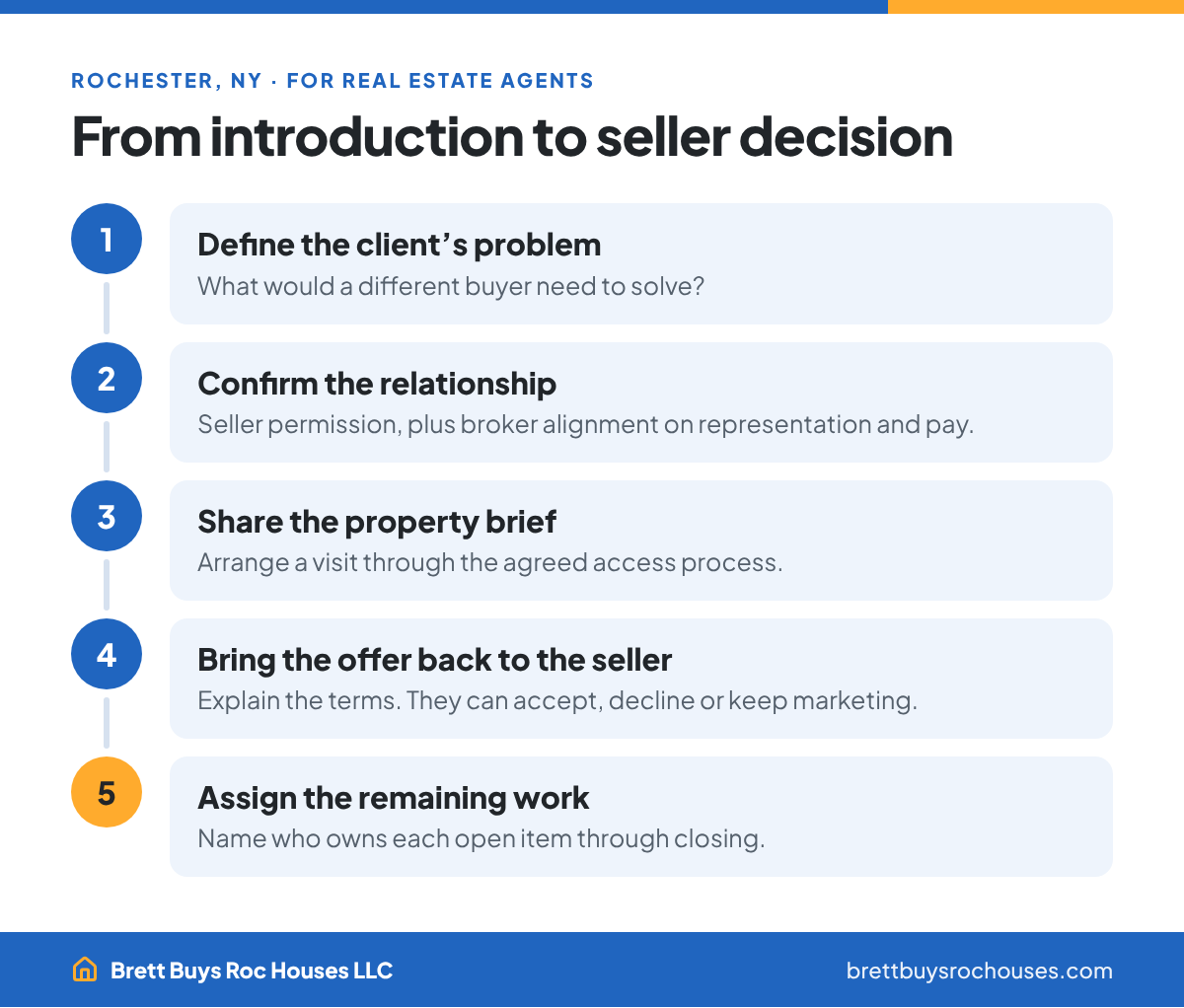
- Define the client’s problem. Identify what a different buyer would need to solve and why an investor conversation is relevant.
- Confirm the relationship. Get the seller’s permission and align with your broker on representation, compensation, and communication.
- Share the property brief. Arrange a visit if there is a potential fit, using the agreed access process.
- Bring the offer back to the seller. Explain its terms and outstanding questions. Give the seller space to accept, decline, or continue marketing.
- Assign the remaining work. If the seller proceeds, identify who owns each open item and how everyone will receive updates through closing.
This gives your client a defined decision instead of another open-ended sales conversation.
Questions agents ask about working with investors
Can I bring an investor to a property I already have listed
Yes. An investor can be a prospective buyer for your listing. Continue working within your brokerage agreement, agency duties, and applicable requirements. Bringing in that buyer does not automatically change who you represent.
Is an investor referral fee the same as a listing commission
No. They describe different compensation arrangements. Whether either applies depends on the services, agreements, and parties involved. Do not assume one is added to the other. Have your broker confirm the terms before proceeding.
Will I automatically get the listing after the investor renovates
No. Future representation needs its own agreement. Ask about the investor’s plans, but remember that renovation, resale, and rental decisions can change.
Should I send the seller directly to the investor
Only after you clarify your role and get the seller’s permission. If you represent the seller and expect to coordinate the transaction, establish that communication route first. A warm introduction should make the next step clear to everyone.
Talk through a Rochester property with Brett
If you have a property where an investor conversation could help, start with the situation you are trying to solve. We can discuss whether it fits our buying process and how to coordinate the next step with you and your brokerage.
Brett Buys Roc Houses LLC has an A plus BBB rating and more than 100 five star Google reviews. You can also review our agent referral resources before reaching out.
Call 585-299-9709 or contact Brett Buys Roc Houses to discuss the property and the agent’s role. Start with the client’s needs, and we can work out whether there is a useful next step.