
If you are dealing with bad tenants in Rochester NY, start by identifying the specific problem and checking your records. Unpaid rent, property damage, and an unresolved repair complaint call for different responses. From there, you can consider a written resolution, management help, legal action, or whether you want to continue owning the rental.
I own rental property and Brett Buys Roc Houses LLC, and I have more than 15 years of real estate experience. My starting point is simple: what needs to change for this property to work for you again? Sometimes the answer is better management. Sometimes the owner is ready to move on.
Calling someone a bad tenant does not tell you what to do next. A clear description of the problem does.
Separate a tenant problem from a property or management problem
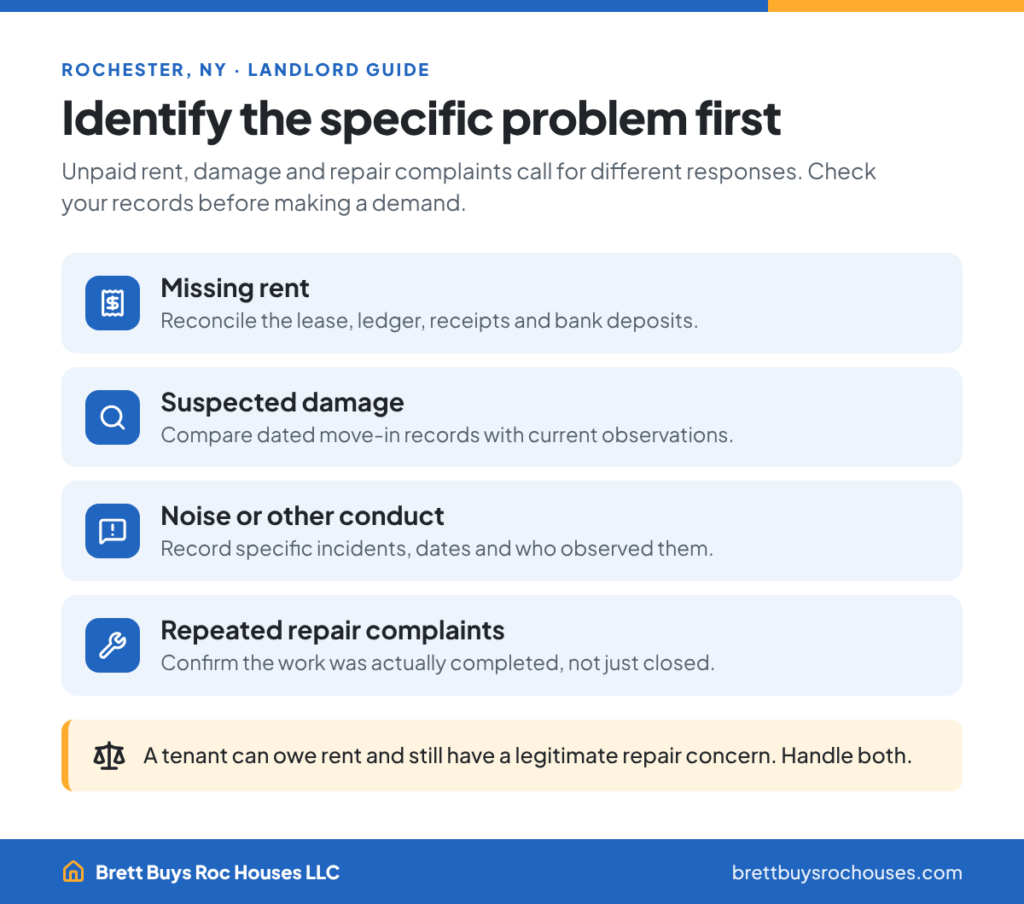
Before making a demand, write down what happened, when it happened, and what supports your understanding. Avoid combining every frustration into one complaint.
- Missing rent: Reconcile the lease, rent ledger, receipts, and bank deposits. Confirm payments were credited to the correct unit and month before stating a balance.
- Suspected damage: Compare dated move-in records with current observations gathered through lawful access. Distinguish a maintenance issue or ordinary wear from damage you can document.
- Noise or other conduct: Record specific incidents, dates, and who observed them. Identify the relevant lease provision rather than relying on a general description such as “disrespectful.”
- Repeated repair complaints: Check whether the work was actually completed. A closed maintenance ticket is not proof that a leak stopped or the heat works.
A tenant can owe rent and still have a legitimate repair concern. Handle both issues. If a manager is involved, request the underlying records, including payments and completed work orders, before deciding what action to take.
Keep essential repairs moving while you address the dispute
Do not let a disagreement become a reason to put required maintenance on hold. Respond promptly to safety concerns, arrange lawful access, and document the repair and any access problems.
The New York Attorney General explains the warranty of habitability: residential tenants have a right to safe, livable housing, and qualifying conditions can affect a rent dispute. Ask your attorney how the facts apply before dismissing a tenant’s complaint or demanding a disputed amount.
Rochester’s Landlord Tenant Bill of Rights and Responsibilities also addresses maintenance, recordkeeping, and tenant complaints. Keep your Certificate of Occupancy and other applicable property requirements current.
Choose a response that fits the actual problem
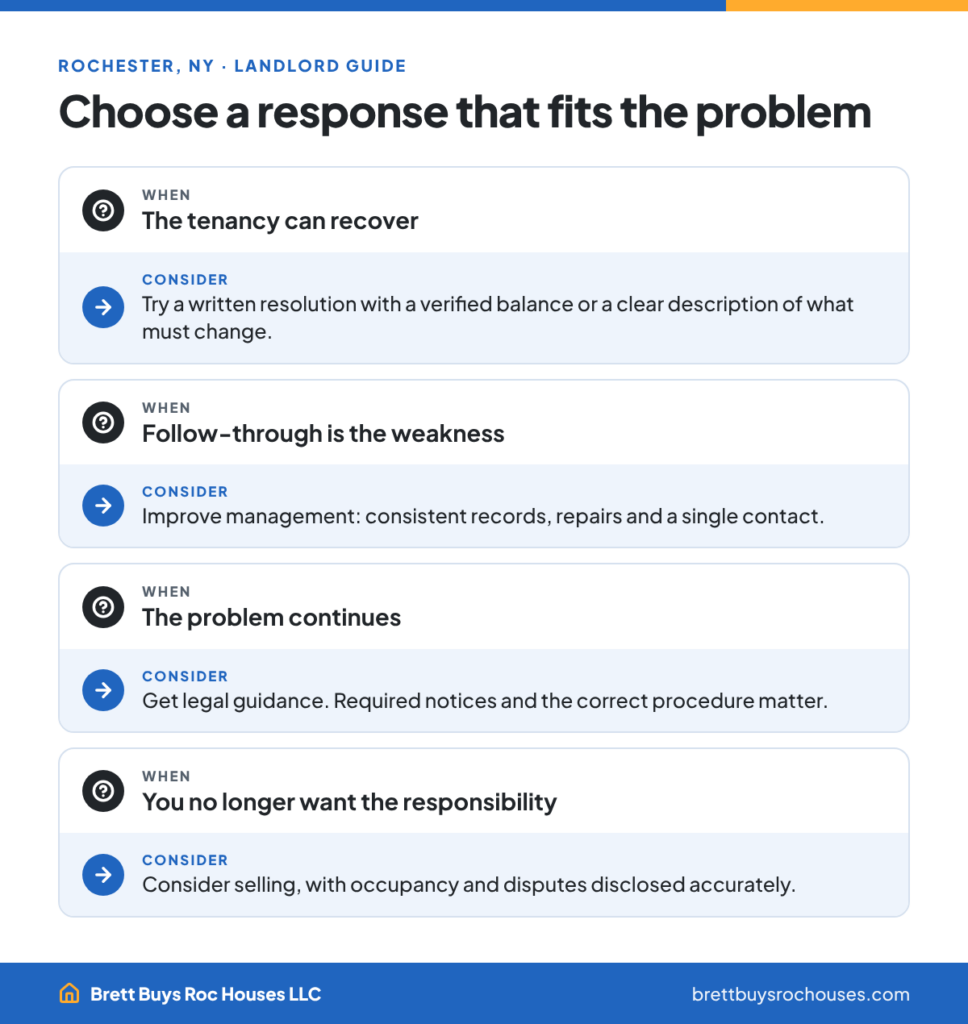
Try a written resolution when the tenancy can recover
If the problem is specific and the tenant is willing to discuss it, put the proposed solution in writing. For a payment issue, that means a verified balance and a realistic proposal. For a conduct issue, describe the behavior that needs to change and how you will review progress.
Get legal advice before signing an agreement that changes payment obligations, settles claims, or affects possession. An ordinary email exchange is not a substitute for a legally required notice.
This approach is useful when there is a workable path forward. Repeating the same verbal promise without checking whether anything changed can leave you in the same position a month later.
Improve management when follow through is the weakness
You may want to keep the rental but stop handling every call yourself. A capable property manager can coordinate repairs, maintain records, and provide a consistent contact for the tenant.
Ask what the manager will report and when. You should be able to see rent collected, outstanding balances, open repairs, completed work, and the next action on unresolved problems. Agree on repair approval limits and how urgent issues will reach you.
Management helps when the missing piece is execution. It cannot erase an existing dispute or replace a landlord-tenant attorney when legal action is needed.
Get legal guidance when the problem continues
Persistent nonpayment or serious lease issues may require a formal response. Bring your attorney the lease, ledger, communications, repair history, and any notices already delivered.
New York Courts distinguishes nonpayment and holdover cases. The reason for seeking possession affects the process. Required notices and service matter, so have counsel confirm the correct procedure for your tenancy.
The City of Rochester has adopted Good Cause Eviction protections. Coverage and exemptions need to be checked for the particular property. Do not assume an expired lease automatically allows you to end a covered tenancy. A Rochester mailing address also does not establish that a property is inside city limits.
Consider selling if you no longer want the responsibility
After reviewing the situation, you may decide the rental no longer fits your goals. That is a different decision from whether a particular tenant has violated the lease.
If you explore a sale, disclose the occupancy, lease, payment history, and disputes accurately. Ask whether the buyer will evaluate the property with the tenants remaining. Have your attorney confirm the obligations that continue or transfer.
Do not promise an empty property when you do not have a lawful, reliable path to deliver it. Selling is a change in ownership, not an automatic solution to a possession dispute.
Common mistakes that make a difficult tenancy harder
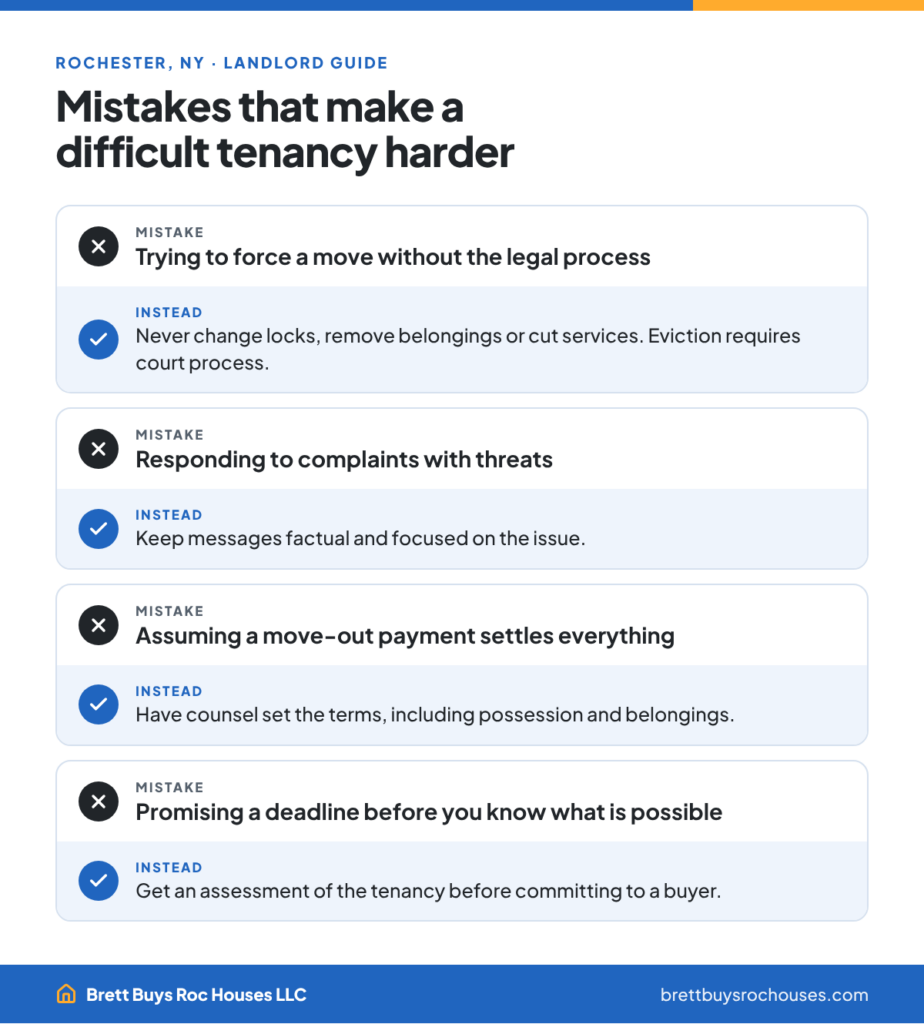
Trying to force a move without the legal process
Do not change locks, remove belongings, or cut off services to pressure a tenant to leave. A landlord cannot carry out an eviction simply because rent is unpaid. The New York Courts eviction guidance explains that an eviction requires court process and enforcement by an authorized officer.
Responding to complaints with threats
Keep messages factual and focused on the issue. Avoid insults, repeated demands, or threats tied to a tenant reporting property conditions. Good-faith complaints may carry legal protections; let your attorney assess any proposed enforcement action.
Assuming a move out payment settles everything
A voluntary move-out agreement, sometimes called cash for keys, requires careful terms. Have counsel address the move-out date, payment conditions, possession, belongings, and any claims being settled. Security deposit obligations need separate attention.
A tenant does not have to accept your proposal. A signed agreement also does not authorize you to force someone out if they remain.
Promising a deadline before you know what is possible
An owner’s preferred date is not a court schedule or a guarantee of vacant possession. Budget for uncertainty and get an assessment of the actual tenancy before committing to a buyer, contractor, or replacement occupant.
A hypothetical duplex example with an overlooked payment
Consider a Rochester duplex with monthly rent of $1,500 for one unit. The owner’s ledger shows two missed payments and a $3,000 balance. The tenant disputes the amount and has also reported a bathroom leak.
Before sending a demand based on that ledger, the owner compares it with bank records. A $1,500 payment was received but posted to the other unit. The ledger needs correcting, and the remaining claimed rent balance is $1,500 before considering any other disputed items.
The repair file also shows that a contractor was contacted, but no visit was completed. The owner arranges the repair and takes the corrected records to an attorney to assess the remaining dispute.
In this hypothetical example, the outcome is a corrected account and a repair moving forward. It does not establish how a court would decide the balance or whether the tenancy will continue. The owner can now make the next decision using facts instead of an overstated account.
Build one file before your next decision
Organize the information by unit so a manager or attorney can understand the situation without reconstructing months of conversations.
- Gather the tenancy documents. Include the lease, renewals, amendments, and relevant notices with delivery records.
- Reconcile the account. List rent due, payments received, and credits by date. Identify disputed amounts separately.
- Create an incident timeline. Record facts, supporting messages or photos, and the response to each issue.
- Update the repair record. Show what remains open, who is responsible for the next action, and whether completion was confirmed.
- State your goal. Decide whether you want to preserve the tenancy, improve management, pursue a lawful end to the tenancy, or explore leaving rental ownership.
For housing questions and available local help, Rochester’s eviction prevention resources include services for landlords as well as tenants. Review the eligibility and purpose of each resource.
Questions Rochester landlords ask about difficult tenants
What should I do first when a tenant stops paying rent
Check the account, confirm the unpaid amount, and review any related complaints. Contact a landlord-tenant attorney promptly about required notices and next steps. Informal reminders do not necessarily satisfy legal notice requirements.
Can I wait to make repairs until the tenant catches up
Do not withhold required repairs as leverage. Address habitability and safety issues while getting advice on the rent dispute. Keep records of the condition, access arrangements, and work completed.
Does a tenant have to leave when the lease expires
Not automatically. The answer depends on the tenancy, required notices, and applicable protections, including Good Cause Eviction where it applies. Have counsel review the property and circumstances before promising a vacancy date.
Do I have to evict before discussing a sale
No. You can discuss a potential sale while the property is occupied. Whether a buyer will proceed depends on the property and tenancy. Existing rights and unresolved obligations still need to be addressed; a sale does not automatically remove the tenant.
Decide whether keeping the rental still works for you
You do not have to decide to sell just because you are frustrated today. Start with reliable records and advice about your options. You may find a manageable way to keep the property, or decide you would rather put your time and money elsewhere.
If you want to discuss the ownership decision, Brett Buys Roc Houses LLC can review the property situation with you. Our local company has more than 100 five-star Google reviews and an A plus BBB rating.
Call 585-299-9709 or explore our homeowner resources. We can talk through whether a purchase conversation makes sense while your attorney handles the tenancy-specific legal questions.